

About a week ago, Hydroxide posted for the first time on Substack, writing about skeuomorphism.1 If you haven’t encountered the term, it’s the design principle behind why your computer has folders. When personal computers were new, designers needed people to understand them without a manual for mass adoption. So they borrowed from the physical world: a folder icon that looks and behaves like a manila folder, a trash can that looks like a trash can. The new technology wore the costume of something already understood.
Food works the same way. When you’re designing a flavor system for a completely new product, you’re not targeting the thing in the abstract. You’re targeting what people already expect the thing to taste like. The folder doesn’t just have to look right. It has to perform like the one people already have on their desk.
That distinction, between the idealized version of a food and the version people actually carry in their heads, is one of the most consequential constraints in product development. Nobody learned it more than the alternative protein world.
The Wrong Folder
When Impossible Foods launched about a decade ago, the economics of plant-based meat were brutal. Building a genetically modified yeast capable of producing soy leghemoglobin2 at scale costs serious money. The only way to make that pencil out was to price against premium beef, specifically grass-fed. This meant a premium flavor target, a premium bleeding-burger experience, and a premium price point to match.
The logic made sense on paper. Grass-fed beef carries cultural weight. It signals better farming, cleaner inputs, a more considered relationship with the animal. If you’re asking someone to pay a premium for a plant-based patty, you want them to feel like they’re trading up, not across.
The sensory reality didn’t follow. Most Americans eat corn-fed, commodity 80/20 ground beef. That is the reference point. That is the folder already open on the desktop. Grass-fed beef reads differently to a palate trained on feedlot corn, leaner, sometimes gamier, occasionally carrying what trained tasters call “off-notes” and what most people would just call wrong. When early Impossible prototypes were designed to taste like grass-fed beef and put into sensory studies against conventional beef, they didn’t consistently win.
So the R&D team recalibrated. They moved the target from the aspirational benchmark to the actual one. They stopped designing for the consumer people imagined themselves to be and started designing for the consumer standing in front of the refrigerator case at 6pm on a Tuesday. That pivot, unglamorous and invisible to most people who ate the burger, was where the product started working.
Same Problem, Different Kitchen
I saw this from the inside when I was at Simulate. We were building a chicken alternative, which meant the first question in the room wasn’t “how do we make it taste like chicken”, it was “which chicken?”
Rotisserie chicken is not the same product as fried chicken. Chicken soup pulls entirely different compounds forward than a poached breast. Each preparation builds a different aromatic signature, hits different Maillard3 thresholds, lands differently in the mouth. They all taste like chicken the way all folders look like folders, but the basecode underneath is distinct.
I brought in The Chicken Issue of Lucky Peach at one point, an entire magazine dedicated to one ingredient, including a piece on the flavor biodiversity that exists across breeds. Chickens raised slowly on varied diets produce meat that tastes nothing like what you find in a standard grocery case. Most Americans will never eat any of them. What we eat is the Cornish cross, the broiler, optimized over decades for rapid growth and maximum yield. Familiar, mild, and almost totally without edges.
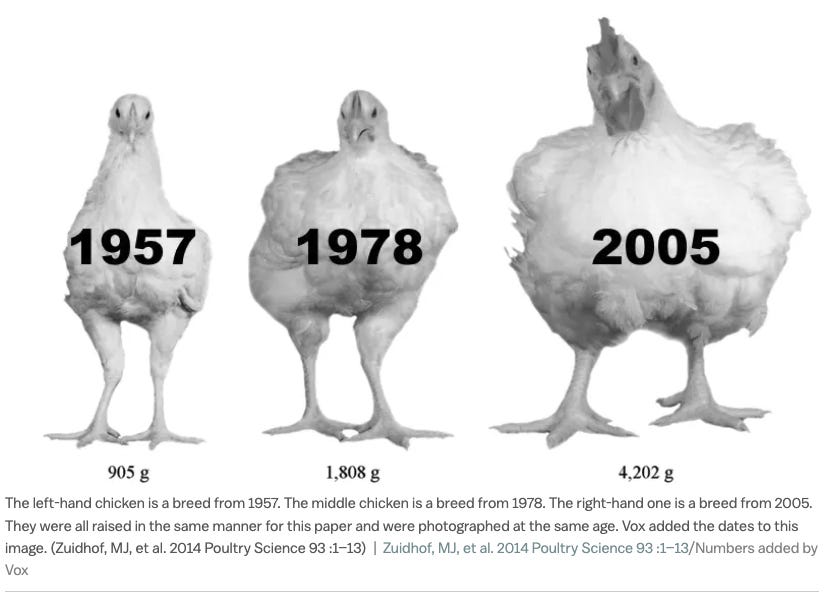
That’s what “it tastes like chicken” actually means. Not that the flavor is simple, but that it’s so universally internalized it functions as a cultural data point rather than a description. Everyone knows exactly what you mean. That shared expectation is the target. It’s also the folder you have to build.
I spent a lot of time trying to understand what that folder actually contained. I made reaction flavors in a pressure cooker, sealing amino acids and reducing sugars together under heat and pressure to drive Maillard reactions and capture what came off. I filled ampules with the results, each one a slightly different variable, temperature, ratio, time, and spent hours smelling the differences. I also tried to distill chicken itself, the way Ben Reade documented at the Nordic Food Lab: a pressure cooker, homebrew tubing coiled in ice water, vapor condensing and dripping out the end as a liquid that looks completely like water. Transparent, odorless to look at. Then you smell it and it’s overwhelming, pure chicken aroma in a few drops. The top notes are all there and nothing else.

That’s the difficulty. What you collect in that distillate is real, recognizable, and almost impossible to stabilize. Those volatile aromatic compounds are exactly what makes chicken smell like chicken the moment it hits a hot pan, and they’re also the first thing to evaporate, degrade, and disappear when a product sits on a shelf or gets frozen and reheated. But the distillate was never going to go into a vegan chicken nugget. What it gave us was a map: here is what you are actually chasing, here is how volatile it is, here is how quickly it disappears under the conditions of manufacturing, freezing, and reheating at scale. That understanding was the starting point for the work we did with external flavor houses, building a system that could survive the supply chain and still land in the right place in someone’s memory when they bit into it.
Impossible’s R&D team figured this out through formal sensory studies. We figured it out in a conference room with a food magazine and a pressure cooker in the test kitchen.
Whose Folder Are You Building?
This is where the “Developer’s Dilemma” gets uncomfortable. The question in the R&D war room is never purely technical. It’s always, underneath everything, about who you’re designing for.
There are two consumers in the room. The first is the person your marketing team wants to reach: someone who cares about sourcing, reads labels, who would choose grass-fed or free-range or heritage breed if cost and availability allowed. The second is the person who will actually buy the product repeatedly: someone whose palate was formed by commodity inputs, who has a strong and largely unconscious model of what this food is supposed to taste like, and who will notice immediately when something is off, even if they can’t say why.
You cannot build a functioning brand for the first consumer alone. The math doesn’t work and the repeat purchase rate won’t hold. But building entirely for the second consumer means losing the story that got people to try the product in the first place.
The decline of plant-based meat has been written about extensively, with diagnoses ranging from price to nutrition to texture. But underneath most of those explanations is a skeuomorphism problem. The products were positioned for a consumer with aspirational values and a familiar reference point. They assumed that someone who cared about the environment would be willing to update their sensory expectations, that the folder could look a little different and people would still know what to do with it. Many didn’t. Omnivores weren’t going to trade texture and nutrition for a burger that almost tasted like a burger. And committed vegans, it turned out, were never that interested in verisimilitude to begin with. Go figure.
So when you pick something new off the shelf, it’s worth asking: whose palate was this designed for? Not who the marketing is talking to, but whose actual sensory memory was the development team trying to hit.
Skeuomorphism in food is not about aesthetics. It’s about market access. The folder has to look like a folder, yes. But it also has to open the right way, hold the right things, and feel like something you already know how to use. Getting it right means knowing, precisely, which folder people already have open.
Skeuomorphism is a design principle where digital or physical items mimic the appearance, texture, and functionality of their real-world, often outdated, counterparts
Soy leghemoglobin (LegH) is a plant-based, iron-containing protein derived from soybean root nodules, used to provide a, meaty flavor and red color in plant-based meats. It is produced via fermentation of genetically engineered yeast, deemed safe by the FDA, and functions similarly to animal-based hemoglobin.
The Maillard reaction is a non-enzymatic browning process occurring between amino acids and reducing sugars under heat, creating hundreds of distinct savory flavors, aromas, and a golden-brown color in foods like seared steak, toasted bread, and roasted coffee.