

Social media abounds with recipes for every diet and outcome: keto, macro counts, a line cook demystifying techniques from a nameless Michelin kitchen. I wonder how many reels someone watches before one lands in that perfect overlap of ingredient availability and home cook skill. In my experience there are two outcomes when someone finally takes the leap:
this was delicious, but it took all day
or
this doesn’t even taste that good, and it took all day
Are either of these outcomes what we deserve with our time?
quality vs. technique
I think there is an inverse relationship between ingredient quality and cooking technique. As ingredient quality goes up, the technique required to make something good goes down. A peak-season tomato from a farmers market in August needs a knife, some salt, and maybe a tin of ventresca. That’s it. When I lived in Spain, that exact dish at Bar Desy was one of the most satisfying meals I’d eat during the summer. Three minutes of preparation. No technique. The ingredient did everything.
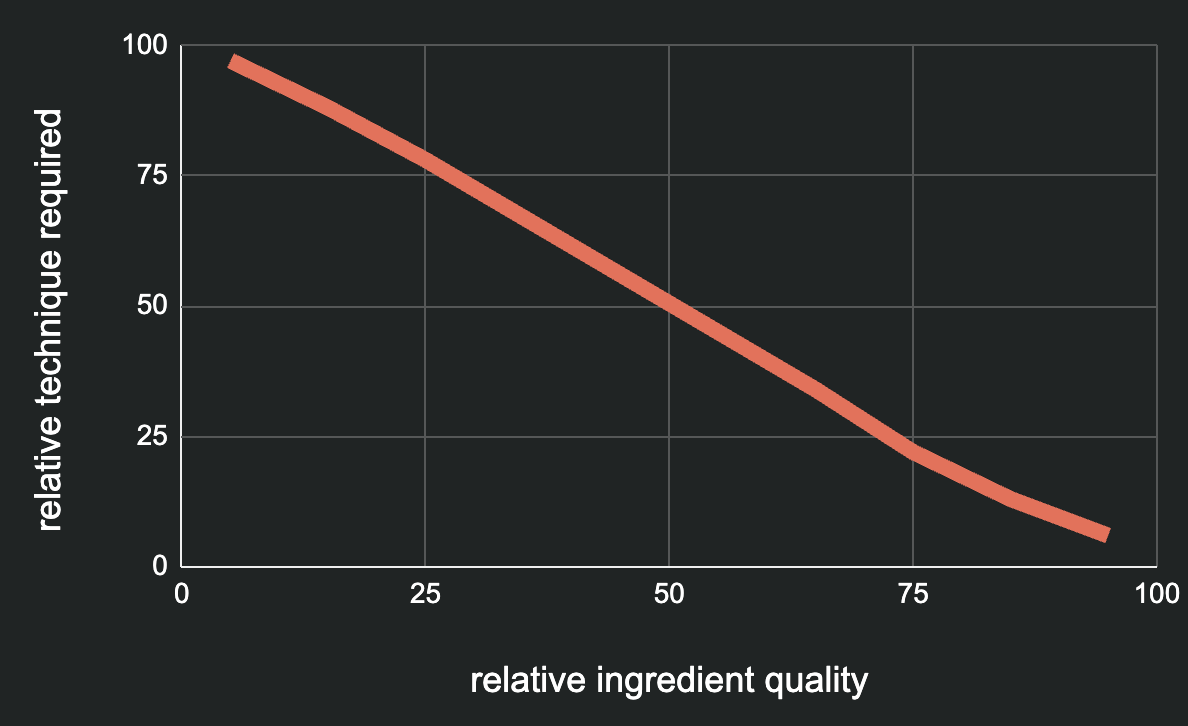
The corollary is just as true. As ingredient quality drops, the technique required to make something worth eating climbs. More acid correction. More fat to carry weak flavor. More heat to concentrate what isn’t there. More time masking off-notes that a better ingredient wouldn’t have. The cook’s job expands exactly as the ingredient’s contribution shrinks.
This holds at the home cook level, but at the professional level it gets more complicated. The best chefs in the world often have access to exceptional produce and still apply significant technique, but the relationship between the two is different. At Blue Hill or anywhere serious farm-to-table cooking is happening, technique serves the ingredient rather than substituting for it. Molecular gastronomy took the opposite route and pushed technique to almost entirely decouple it from ingredient quality itself. The swing back toward Blue Hill, toward Sweetgreen, toward produce-forward cooking is the market implicitly agreeing with the thesis: when the ingredient is genuinely good, getting out of the way is often the most compelling thing you can do. The home cook rarely gets to make that choice.
Our food system has spent decades optimizing for the wrong side of that curve. The priority has been shelf life, uniformity, and year-round availability, not flavor. The result is that most home cooks are working with ingredients that structurally require more technique to make edible, at the exact moment when fewer people have the time or interest to develop that technique. The Bar Desy salad is only replicable in August, at a farmers market, if you’re lucky with the variety. The rest of the year the tomato needs help, and most home cooks don’t have the tools to give it.
The outcomes are predictable. People get burnt out trying to make mediocre produce taste like something. They stop cooking and reach for highly processed food that has already done the flavor intervention upstream in a factory. Or they outsource the technique requirement entirely to a restaurant or a delivery app, where someone else absorbs the labor of making commodity ingredients edible. The food system created this problem and then built an entire industry on top of the gap it left open.
build your capsule wardrobe of cooking techniques
The exit ramp is less sexy than the TikTok content landscape suggests. People who cook well at home tend to make the same things so often that those things become second nature. They become fluent in the way their oven, pots, and pans work. They know when their knives need sharpening (and that that’s more valuable than the $100+ blade they bought at a knife shop)
A clear example for me was learning how to cook rice. I’ve cooked rice at least once a week for so many years that I’ve learned how different pots behave, what type of rice gives me the texture I want, and how to adapt from there. Once I mastered boring-ass white rice, I could add cooked vegetables to it, season it before it cooked, pre-fry the dried rice with spices and herbs and know how much more stock I needed to offset the water content. Each layer had to be built on the knowledge of how to make the simplest version first.
This is what a capsule wardrobe1 of cooking looks like in practice. A small rotation of staples, cooked repeatedly until they stop requiring conscious effort. Salmon, chicken thighs, rice, roasted root vegetables. Not mastered in the culinary school sense, mastered in the sense that you know how they behave and what to do when they don’t behave as expected.
Becoming a capsule home cook2 also means you practice on ordinary produce year-round and learn how to make it sing. So when you find a beautiful ripe heirloom tomato at the farmers market, you recognize the difference immediately and know what to do with it. You’re comfortable cooking Perdue chicken thighs low and slow, so when you buy duck thighs you’re not terrified of wasting the money. The ordinary builds the reference point, and that reference point is what lets you handle the extraordinary.
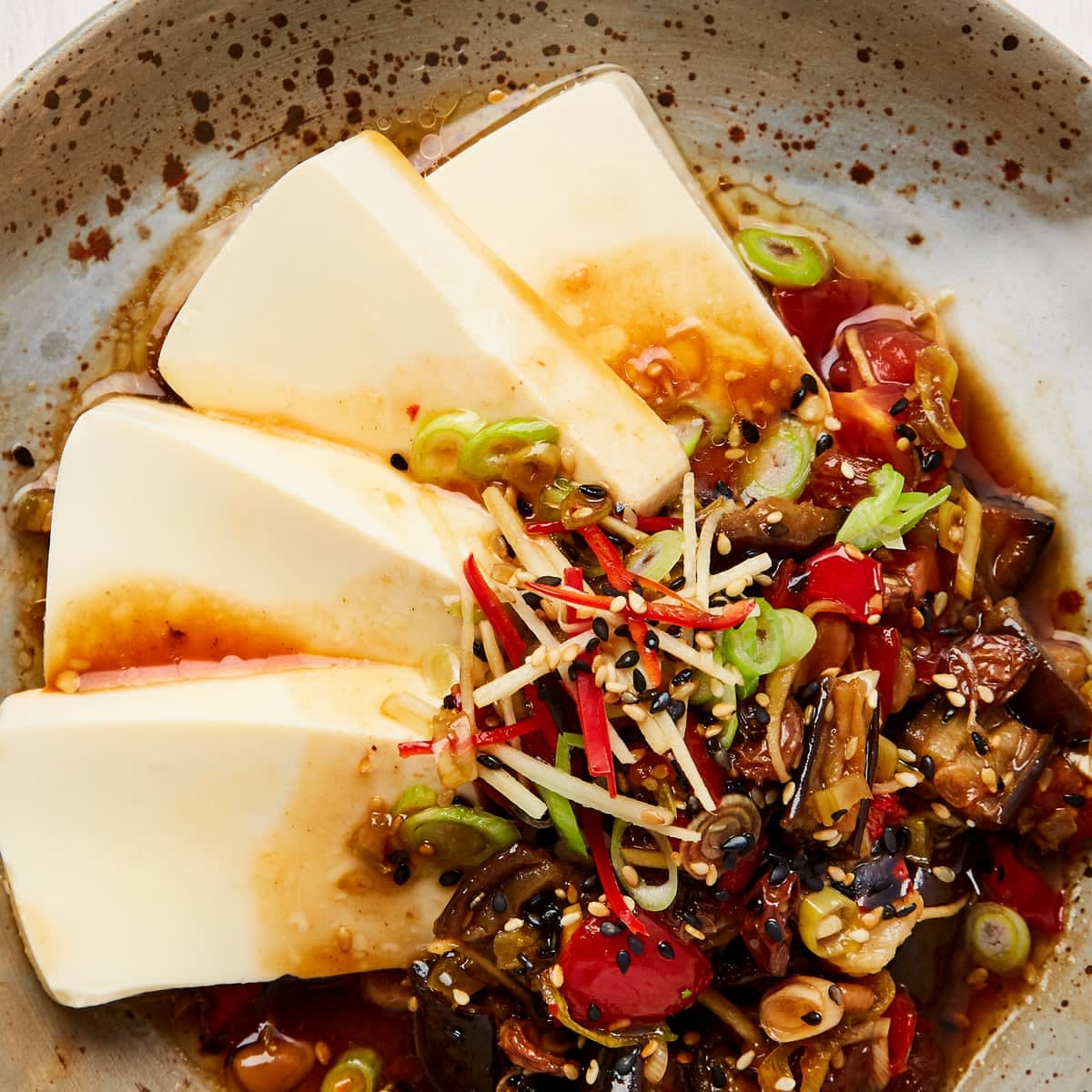
And when you do decide to pick up a cookbook (or a reel!) and make the Ottolenghi silken tofu caponata for your dinner party, it becomes a layering of skills you’re already comfortable with, applied to slightly new presentations and ingredients. The dish that looked intimidating from the outside is just a slightly different walk through the same park. That’s a different relationship to cooking than the one social media is selling. It’s slower to build and actually works.
If you’re not sure where to start, reach out. I’m thinking about turning this into a series: a practical look at the staples worth mastering, how to read when an ingredient is different from what you’re used to, and how to build from there. The capsule wardrobe is a small thing that compounds. It’s worth starting somewhere.
A capsule wardrobe is a curated collection of versatile, high-quality staples that helps limit decision fatigue and be more conscious of fashion purchases.
A capsule home cook would learn a curated set of techniques to help limit the overall burden of cooking and even the playing field with a range of produce quality