

I wanted to reflect on a few overlapping thoughts of mine: the power of marketing, the responsibility of growing trust with a community, and how the burden of research is now put into the hands of consumers. I’ve thought about how it pertains to me as a product person trying to learn how to talk about Mez. I’m publishing this as my first paid post because it captures a moment in that thinking that feels comfortable to share. Thanks.
I was always a tad embarrassed how drawn I was to the self-help section at Barnes & Noble as a child. Looking at all the covers of pop psychology books left me dreaming at checkout, of how I could be better. Whatever that amorphous term ‘better’ meant to me at the time (and now, frankly). What drew me in wasn’t a grand plan to reorganize my life and zenmaxx in the world around me, but that I felt like part of a community. There was a universal desire to understand life, and I knew other folks would be buying this book to become ‘better’ too. And I don’t mean specifically becoming ‘better at’ cooking necessarily. To me, ‘better’ meant renovating how I approach the world.
Sports were a huge aspect of my life when I learned about self-help, so naturally ‘better’ meant ‘athletically’. There were books on a famous athlete’s mindset, but nutrition science wasn’t as accessible in our tiny town. It was a different time. In 2009, there weren’t nutrition or supplement brands like there are today, nor were there social influencers breaking down scientific studies (real, fake, or otherwise). There were books on the South Beach Diet, the battered Atkins approach, and one that scared me for some reason: Jenny Craig. If I wanted to look up studies, I still basically had to go to a library and pull them out. Damn, I never wanted to scratch out those last ten words.
What I’m getting at is that when we were doing long football practices and had to bike a few miles home after early morning workouts, we were told to drink quarts of chocolate milk for the protein and sugar. Essentially, my coach prescribed this as the way to get enough calories for two-a-day practices, sourced from the Citgo down the road. One hand on the bike. Another on a quart of ice-cold chocolate milk. My buddy, my little brothers, and I would ride home, trying to balance on the white line along the shoulder of the road and making milk mustaches cool.
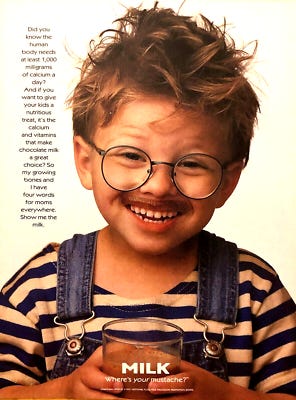
There was a kinship there. Working out together, or at least in the same room, and then eating (...er, drinking?) something together, unaware we were making a memory.
I think this kinship is what many people were seeking as we got older. We outgrew the books on the shelves of B&N. People slowly replaced time spent thumbing through a book with a podcast on a morning commute, making use out of “wasted” time. Podcasts were direct access to people on the front lines of ‘better’. We got to hear experts talk about their research and the experience they could share with us mere mortals. What could possibly be better?
Andrew Huberman came into my orbit through the Tim Ferriss podcast, and was fully vetted by my younger brother telling me he listened fairly often. I found kinship again in knowing there were hundreds of thousands of other people listening too, all interested in getting ‘better’. There were real things I took away from his podcasts that I still incorporate into my life, whether because of the placebo effect or the habit that came with it. I gave many chances to his two-hour-long sermons before deciding that I respected his long-form discussions, but IG Reels were easier for me to digest his wisdom.
In the middle of that Huberman phase, Peter Attia was interviewed. He was on Tim Ferriss as well, so I trusted him to a degree. Though, I never listened to The Drive much because I couldn’t latch onto him. Maybe it was because he seemed to parrot Huberman, though I’m sure they shared studies among themselves and could converge the same recommendations from it. But also couldn’t do HuberDaddy’s pods and another guy’s similar takes. I was skeptical of his medical to consulting transition but I agreed with his general goal of lengthening healthspan rather than lifespan.
Despite my lack of interest, he cultivated a massive kinship: 1.6 million followers on Instagram, over half a million on X. Loads of folks that had more than a passive interest in him, and trusted the science he discussed. Words don’t fall on deaf ears at that scale of a community. If even five percent of your audience acts on what you say, that becomes football stadiums worth of people buying the latest supplement. This hard-fought-for trust turns into an asset with a very real price tag. He’s neither the first nor the last example of this, but incentives can outstrip decency.