

In 2024, I had been knocking around the idea in my head that I should try doing a year sober. A close family member of mine had decided to stop drinking, and I admired their decision. I had heard so many great arguments for it, and frankly, my relationship to alcohol changed after the Pandemic started. I slowed down and began leaning more into outdoor activities that were possible in NYC at that time, mainly running and biking. Both of these are much more enjoyable without the buzz or the aftereffects of a night well spent out. I had realized that there hadn’t been a year since 2010 where alcohol wasn’t an aspect of at least the weekend.
I have still spent more time not drinking alcohol than bellying up to the bar. Frankly, I wanted to experience that again for an extended period of time to understand if it was what I wanted. The problem was that I didn’t actually want to quit drinking. I wanted to understand my relationship to it more fully. And to be clear, alcohol has always been adjacent to my life and work, from hop farms to Bell’s to Empirical. This wasn’t a rejection of that world so much as a pause to look at it head-on.
I knew that we had a big year with our pre-wedding festivities and that there were realistically times when I wanted to drink to feel more a part of the celebration, like my bachelor party, for example. Thirty felt like the right number to me. Two drinks a month, plus a few to sprinkle around on special occasions. Going fully sober wasn’t honest. I also knew I’d rationalize anything if I didn’t put constraints around it. So I treated it like a design problem and built a Drink Budget Bill of Rights:
Trying an alcoholic drink is not considered a drink as long as it does not exceed one taste per cocktail.
A drink is a standard volume drink.
12 oz (354 mL) beer
5 oz (150 mL) wine
1.5 oz (45 mL) shot
Drinks that are labeled non-alcoholic do not count as a drink, for example Athletic Brewing.
With policy in hand, I took the leap.
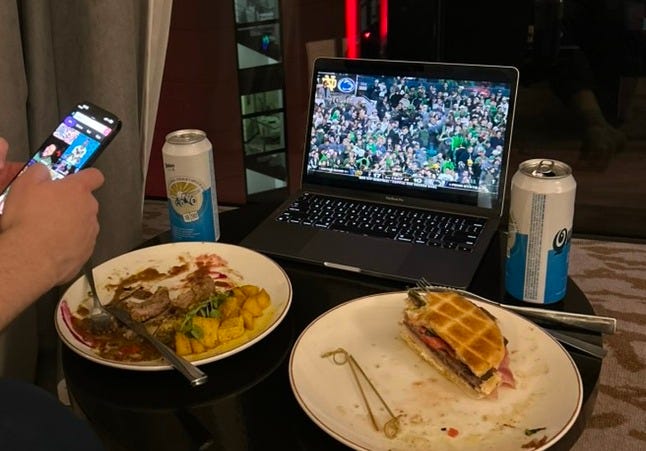
In the first half of the year, Notre Dame made it to the National Championship, and Mez brought us to the land of Malbecs in South America. Neither of these were ideal environments for keeping a drinking goal in check, but I managed to limit myself to two Quilmes and a taste of red wine, which according to my own rules did not count.
Not long after, we made it out to Expo West in Anaheim, my first time at the show. Southern California was a welcome break from Chicago, and we had a few moments on chilly beaches watching Pacific sunsets. During a dinner with a vendor, we ended up at Downtown Disney, and by then I had gotten into the habit of ordering NA beers. I went with a classic from the growing category, Heineken 0.0.
When the waiter dropped it at the table, he announced it loudly as a “diet beer,” sneering for a cheap laugh. We had no rapport with this person, which would have instantly softened it for me. Instead, it landed heavier than I expected. I got a glimpse of the small, uninvited slights the NA community absorbs in public spaces. It would have made more sense if it were 1994, but given how much drinking habits have shifted, and that this person worked in hospitality, I was surprised. It was the first time I really felt how visible a choice not to drink can become, even when you are not trying to make a statement.
I am not a victim here, but it gave me a peek behind the curtain at how these small moments can add up.
By May, I had started feeling self-conscious about the goal itself. Twenty-one drinks were gone, and we were not even halfway through the year. I felt the love from friends and family who gifted us bottles of champagne, wanted to buy us drinks to celebrate our engagement, and showed care in the ways they always had. Not indulging felt like refusing a shared ritual, one we had been participating in since college, or since whenever we first met and tied one on together. There was guilt in that, both for myself and for them.
That is when it became clear to me that the measurement and the goal were not aligned. The point was never the number. The point was to understand how drinking affected, or colored, how I acted and how I felt I was expected to act in certain situations. There were plenty of events where I did not drink and realized that I could have just as much, if not more, fun without a malt beverage in hand. I kept coming back to how much I loved running or walking on weekend mornings, free of work and finally having a moment of clarity away from the buzz of the world. Why would I want to cloud that with a hangover or poor sleep?
What mattered to me about spending time with people was being present with them. If that was true, then why assume there was only one way to do it, only one acceptable punctuation mark for time spent together?
In some ways, this drink budget made the experiment trickier than going cold turkey. I always felt the sense that someone might be anticipating this hang as one of those “special occasions,” even if that was objectively not true. Swearing it off completely would have closed the door. Leaving it ajar meant constantly negotiating the moment. That tension conflicted with another goal I had for the year: reconnecting with people. When you see an old friend, an early evening bar hang carries a kind of nostalgia that a late afternoon coffee does not always replicate. I have grown to love both, but there are still times when a drink punctuates or commemorates a hang in a way a cortado has not figured out yet.
I did not quit drinking. I also did not learn what I expected. What I learned was how much meaning I can outsource to a glass, and how uncomfortable it can be to ask whether that meaning still fits.
love this thank you for sharing!