

On the last episode of…
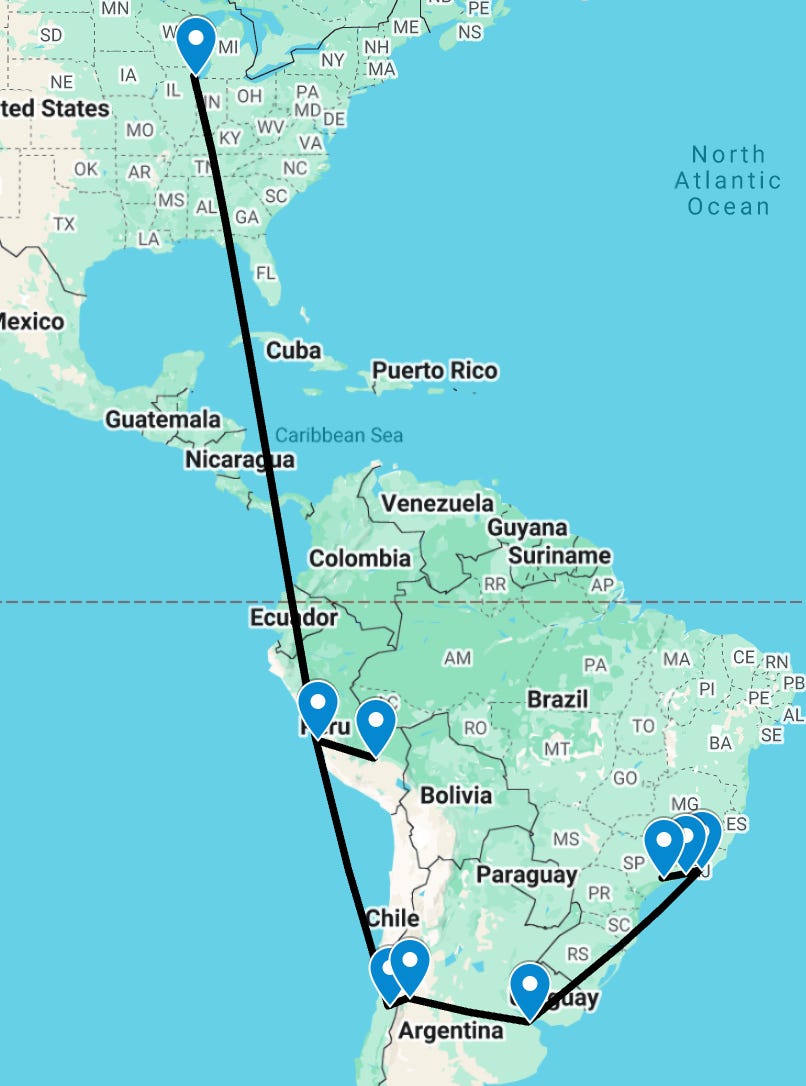
The flight from Lima to Santiago, Chile is not for the faint of heart, we legitimately thought we were going to be the next Uruguayan Rugby Team at about two in the morning. I have always hated roller coasters and we were certainly along for a bumpy ride.

It turns out that the flight path we were taking has consistently been ranked as one of the most turbulent routes in the world. The tallest stretch of the Andes is between Santiago and Mendoza, Argentina which makes for a very unique wind effect that we were feeling the full brunt of: Viento Zonda. Essentially, the Zonda is a wind that screams down the Andes’ eastern slope into Mendoza and northern Argentina, reaching up to 150 mph. It starts in the afternoon most days between May and November (perfect timing on our part), lasts anywhere from an hour to three days depending on how much the weather gods hate you, and moves in because polar maritime air gets compressed and heated as it crosses the Andes crest at 20,000 feet.
Thankfully, it was less intense on the leg from Santiago to Mendoza, but we were basically paid to test our pilot’s ability to white-knuckle the yoke while we held strangers’ hands in the back rows.
We got yellow fever vaccines for Brazil while we were in Lima. We’d highly recommend looking at travel vaccinations in the location you’ll arrive at because we spent almost $800 less than we would have for the same care in the USA. Despite this, I had pretty awful body aches from the live vaccine (Fiona was fine!), but I decided to be a real trooper and do the spa and vineyard tours though. When called upon, I will serve.
Recap
Total Miles: 13,087 mi
Miles Traveled: 5,798 mi
Current City: Mendoza, Argentina
Best thing I’ve consumed
Mendoza is essentially the Sonoma Valley of Argentina, known for producing some of the best wine in the world. So naturally, the best thing we consumed was wine.
We learned how only in the last 30 years this had been the case. Prior to the 1990s, Argentine wine was mostly a domestic affair. The country consumed large volumes of inexpensive local table wine, which meant producers didn’t have to concentrate on quality production. Around 90% of the wine produced in Argentina was consumed locally, and when poverty increased in the late 1980s and early 1990s, people could no longer buy wine.
The story of the Malbec grape itself mirrors this collapse and revival. A plague attacked the vineyards of Cahors starting in 1877 and wreaked havoc, destroying the 40,000 hectares that had been cultivated up to that point within a few years. The Malbec clones introduced to Argentina in 1853 were different from other French clones and didn’t prosper in France, so they were never chosen to propagate new planting material. They likely would have become extinct worldwide if it had not been for their immigration to Argentina. Meanwhile in France, the long and rich winemaking history in Cahors disappeared along with their plantings of Malbec, and Bordeaux experienced the same blight plus a frost that destroyed much of their Malbec acreage.
The pivot in Argentina happened during the 1990s. By the mid-90s, Argentina had a handful of international flying winemakers advising its wineries, and this influx of foreign knowledge led to investments in new technology like stainless steel tanks and French oak barrels, plus a different approach to viticulture favoring concentration and maturity of grapes over yield. Malbec, which had been dismissed as a “poor man’s grape” and unknown to most of the world, turned out to be perfectly suited to Mendoza’s high elevation and parasite-free environment.


We visited Zuccardi which was voted best vineyard in the world for three successive years. Neither of us have a ton of knowledge behind wine and our tour guide gave us such a great run down. Elevation, changes in temperature, how rocky or silty your soil is, and the amount of soil studies they do is insane. The final two Malbecs we tried were from their Piedra Infinita (Infinite Rocks) vineyard we had walked through earlier in the day. They were Malbec grapes picked from only a few meters from one another, but couldn’t be more different. One grew on incredibly rocky soil and took more time to come to harvest, while the other was in a more typical soil. We had a ton of fun drinking wine at 9:30 in the morning.
Our wonderful chofer for the day, Coty (who was also our Airbnb’s step-daugther) then drove us to visit at Salentein (currently #12 in the world) for lunch and a tour. The wine was more traditional, using a lot of oak barrels to impart flavor and allow for high rates of oxidation to fight tannic creep. The wine was delicious and their “Cathedral of Wine” was stunning. The back drop of the Andes was sick, the food was lovely, though we mainly chose this spot because they have an art gallery.


